The Road Not Taken by Frank McLynn
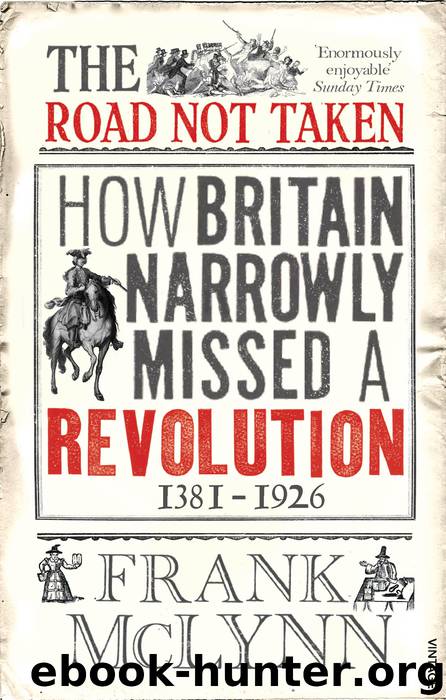
Author:Frank McLynn
Language: eng
Format: epub
ISBN: 9781446449356
Publisher: Random House
12
The General Strike: Prelude
THE GENERAL STRIKE of 1926 presents peculiar problems of interpretation, and needs even more nuanced treatment than previous revolutionary episodes. While there can be no doubt that it was a ‘revolutionary moment’ – in that the opportunity to overthrow an entire political and economic system did, however fleetingly, exist – almost none of the radical actors had revolutionary aims. Yet the government paranoia about ‘red insurrection’, even if deliberately exaggerated, did contain some rationality, since the general strike was the hottest of topics in the early twentieth century. If we return to our trusty trio of revolutionary stages – preconditions, triggers and precipitants – it is clear that part of the deep-seated causality we have to deal with relates to Marxist ideology about the general strike. It should be stated straight away that the concept ‘general strike’ by no means implies revolution. One study at the theoretical level finds four types: the radical, anarchist, syndicalist and socialist conceptions.1 The basic notion is almost as old as history itself, for in ancient Rome in 449 BC the plebeian order used the threat of it to secure reforms and concessions from the patricians: this was the so-called secession plebis.2 Indeed, if one was purely interested in taxonomy, one could extend the classifications manyfold, since it was a popular tactic in the early twentieth century to use the threat of a general strike to try to prevent war: both Jean Jaurès in France and Keir Hardie in England were advocates of this kind of strong-arm pacifism.3 This approach was also attempted to try to salve wounded nationalism and to wring concessions from the occupying power in Japan after 1945, but the ‘American Caesar’ General Douglas MacArthur outlawed it in 1947.4 The term ‘general strike’ is also used loosely to denote a total work stoppage in a given city or community – the ‘general strike’ in Naples, say. Cutting through the luxuriant thicket of usage, we may say that there are really only two kinds of authentic general strike: the total cessation of work within a given nation-state to achieve purely economic and political ends – higher wages, new labour laws, the reform of the voting system, etc; and the general strike used as the prelude to root-and-branch socio-economic revolution. The economic or reformist general strike is really a large-scale sympathy strike. In a sense it can be perceived as a purely negative or defensive phenomenon – what has been termed the ‘general strike of protest’. In British labour history until 1926 there had never been any serious talk of the revolutionary general strike; it was always the reformist variety that was at issue, and even that was in a lukewarm way. The first glimmerings of the idea came in the 1830s when William Benbow, a radical cobbler and lay preacher, came up with the notion of a ‘Grand National Holiday’.5 The Chartists certainly considered the idea, especially in 1842, but they were both too disorganised and ideologically primitive to get
Download
This site does not store any files on its server. We only index and link to content provided by other sites. Please contact the content providers to delete copyright contents if any and email us, we'll remove relevant links or contents immediately.
| Africa | Americas |
| Arctic & Antarctica | Asia |
| Australia & Oceania | Europe |
| Middle East | Russia |
| United States | World |
| Ancient Civilizations | Military |
| Historical Study & Educational Resources |
Underground: A Human History of the Worlds Beneath Our Feet by Will Hunt(12101)
Sapiens by Yuval Noah Harari(5375)
Navigation and Map Reading by K Andrew(5161)
The Sympathizer by Viet Thanh Nguyen(4398)
Barron's AP Biology by Goldberg M.S. Deborah T(4155)
5 Steps to a 5 AP U.S. History, 2010-2011 Edition (5 Steps to a 5 on the Advanced Placement Examinations Series) by Armstrong Stephen(3737)
Three Women by Lisa Taddeo(3437)
Water by Ian Miller(3191)
The Comedians: Drunks, Thieves, Scoundrels, and the History of American Comedy by Nesteroff Kliph(3082)
Drugs Unlimited by Mike Power(2602)
A Short History of Drunkenness by Forsyth Mark(2301)
DarkMarket by Misha Glenny(2213)
And the Band Played On by Randy Shilts(2213)
The House of Government by Slezkine Yuri(2209)
The Library Book by Susan Orlean(2073)
Revived (Cat Patrick) by Cat Patrick(1994)
The Woman Who Smashed Codes by Jason Fagone(1974)
The Absolutely True Diary of a Part-Time Indian by Sherman Alexie(1916)
Birth by Tina Cassidy(1908)
